March 27, 2017

The Google Teacher Tribe Podcast: Matt Miller & Casey Bell

This Week’s Topic in Focus:  Growing your PLN
Each month our Digital Learning Team will feature a connection that we feel exemplifies and supports our mission and goals. Our hope is that you find so much value and worth in that resource that you  decide to add him/her/them to your own Personal Learning Network.  Check out this month’s featured follow:

Matt Miller & Casey Bell

Learn about updates and new feature releases in G-Suite for Education.  Connect with an innovative educator each week.  Get inspired to empower your learners.  Matt Miller and Casey Bell are dynamic tag team partners that will keep you in the know and push you to grow in your educational practices.


Matt Miller (@jmattmiller) is probably most known for his book, Ditch That Textbook.   He is also an active blogger and national presenter.  His blog site is www.ditchthattextbook.com.  There is currently a free ebook being offered with 101 tips on how to ditch your textbook on his site.  Matt is very reflective of the learning process and promotes ideas that empower active scholarship rather than passive reception and regurgitation of memorized facts.  He also frequently provides specific tips and tricks using G-Suite for Education tools which will breath life into your day to day practices.  


Casey Bell (@ShakeUpLearning) is also an active blogger.  You can read her posts at www.shakeuplearning.com.   She has several free ebooks being offered on her site.  Casey is a Digital Learning Coach in Dallas/Fort Worth and she routinely produces great resources for educators using G-Suite for education tools.  


Both of these individuals are worth following on their own right but the reason why I am featuring them together in this post is because, starting in January of this year they’ve combined forces to co-produce a weekly podcast.  I have listened to every episode to date and have taken away a number of new tips, tricks and ideas every single time.  Their channel is called the Google Teacher Tribe Podcast. You can listen using your mobile device (itunes/android) or via your computer at www.googleteachertribe.com.  Sit back and listen and then check out their episode notes to start using what you’ve learned.


Would you like to grow your PLN?  Do you have resources that you would like to share?  We can help you regardless of where you are along the personal learning network path.  See your DLS to kickstart a conversation - Cheryl, Melanie or Kyle.

Contributed by Kyle Mack @ProfKyleMack

March 22, 2017

Using Google to Encourage Students as Creators

This Week’s Topic in Focus:  Using Google to Encourage Students as Creators

Each month our Digital Learning Team will deep dive into a specific feature or tool in Google. This week we will take a look at using Google to encourage students to be creators.
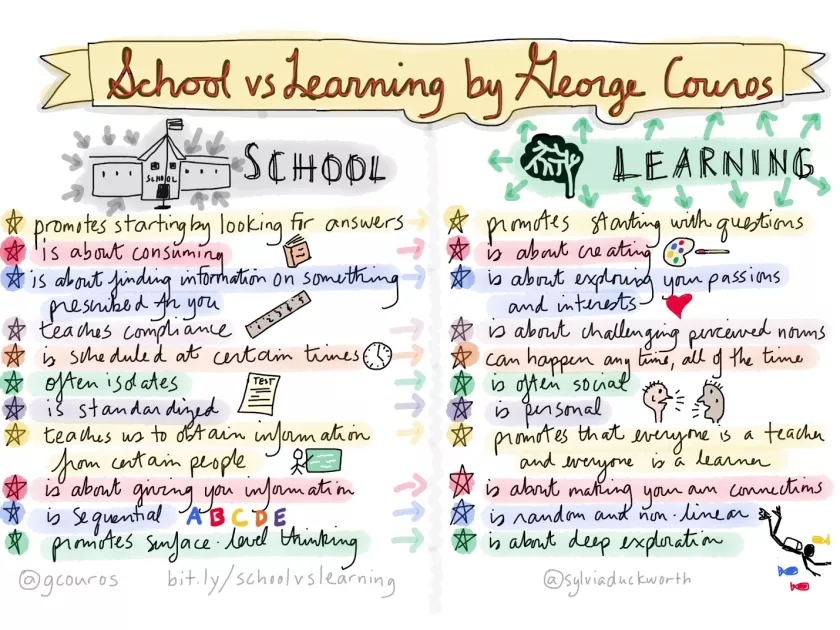
For many educators GSuite for EDU is great for organization and workflow. If you haven't already, consider using Google tools as a way for students to create and show what they know.  George Couros states one of the characteristics of the innovator’s mindset is to be a creator.  
“Creators- Anyone can consume information, but that doesn’t equate to learning.  The Center for Accelerated Learning notes:
         Learning is creation, not consumption. Knowledge is not something a learner absorbs, but something a learner creates.  Learning happens when a learner integrates new knowledge and skill into his or her existing structure of self.  Learning is literally a matter of creating new meanings, new neural networks, and new patterns of electro/chemical interactions within one’s total brain/body systems.”


Explore and consider these Google tools for students to be creators of content.


STUDENTS CREATE


DOCS
SLIDES
SITES
MAPS/YouTube/Drawings
*Shared Doc to create study guides, create individual or collaborative reports
*Write poetry
*Cartoon strip
* eBook
*Choose Your own adventure story
*Digital Storytelling
*Digital portfolio to share the best of their work, show growth and share with the world
*Blog
*My Maps - create a map, tour, share facts and artifacts

*YouTube - create videos to explain a topic, share what they know in creative ways and more
*Sketchnoting
*Diagramming
*Posters


If you would like help implementing any of these ideas in your classroom, see your DLS.

Feel free to use the comment feature to share how you are using Google to have your students create. We look forward to learning from your ideas.

Works Cited
Couros, George. The Innovator's Mindset: Empower Learning, Unleash Talent, and Lead a Culture of Creativity. San Diego, CA: Dave Burgess Consulting, 2015. Print.

March 20, 2017

Innovator's Mindset - Week 3 Reflection

Innovator’s Mindset - Week 3
A group of us aspiring innovators at Forest Hills have joined the second installment of the Innovator’s Mindset MOOC (Massive Open Online Course).  The author, George Couros is the instructor of the course!  It has been my commitment to post reflections from the book, twitter chats and webinars each week. I wrote this up last week and had intentions to add some personal reflections but the week got away from me. Here is last week’s installment:
Image acquired from: http://immooc.org


Innovator’s Mindset Reflection Week 3
Chapters 4-7 Summaries:
Chapter 4 focuses on how relationships between school leaders and educators should be built upon trust.  The author states, “if innovation is going to be a priority in education, we need to create a culture where trust is the norm… In some cases that may mean we, as leaders, have to extend trust to our people before they’ve “earned” it.  
Three things leaders do that inhibit innovation:   
  1. Use the word No
  2. Holding off on trying something new because it might put pressure on others
  3. All concerns of equity for all classrooms, hold back great teachers from excelling in their classrooms
Three things leaders do that encourage innovation:   
  1. Promote competitive collaboration
  2. Develop school teacher rather than classroom teachers
  3. Know and care about each individual you serve to the point where you can make suggestion tailored to their personal growth.


Chapter 5 examines how we begin the process of recognizing what requires innovation. Perspective is the key component to recognizing what needs attention.  In education our end-users are our students.  We need to view our “product” from the eyes of our students.  For many of us, this might be difficult to do.  Perhaps taking a professional day to shadow a student would serve us all well.  Sitting down and talking with our students about how they experience school can help as well.  Complete the same assignments you give to your students.

Chapter 6 investigate the concepts or engagement and empowerment.  This chapter in particular provided substance to a thought that I have been mulling over for some time.  We often speak of engagement in our district and the term feels quite hollow to me personally because engagement seems to translate to entertainment for many.  Entertainment is a primarily a passive activity and requires little effort or grit.  Learning require grit and resiliency.  Rather than striving for engagement our ultimate goal for our learners should be empowerment.

Chapter 7 sets the stage for pursuing a learner empowered classroom. This chapter identifies 8 key ingredient to a learner centered classroom: voice, choice, time for reflection, opportunities for innovation, critical thinkers, problem solver-finders, self-assessment and connected learning.

Contributed by Kyle Mack @ProfKyleMack